Showing posts with label Data Protection. Show all posts

10 June 2020

Free Data Protection and Recovery Review

Can you trust in your current data protection and recovery solution?

We appreciate, especially in the current climate, that all organizations want to ensure they have fully functional and cost-effective data protection and recovery solutions that when required can quickly and efficiently recover vital data. 
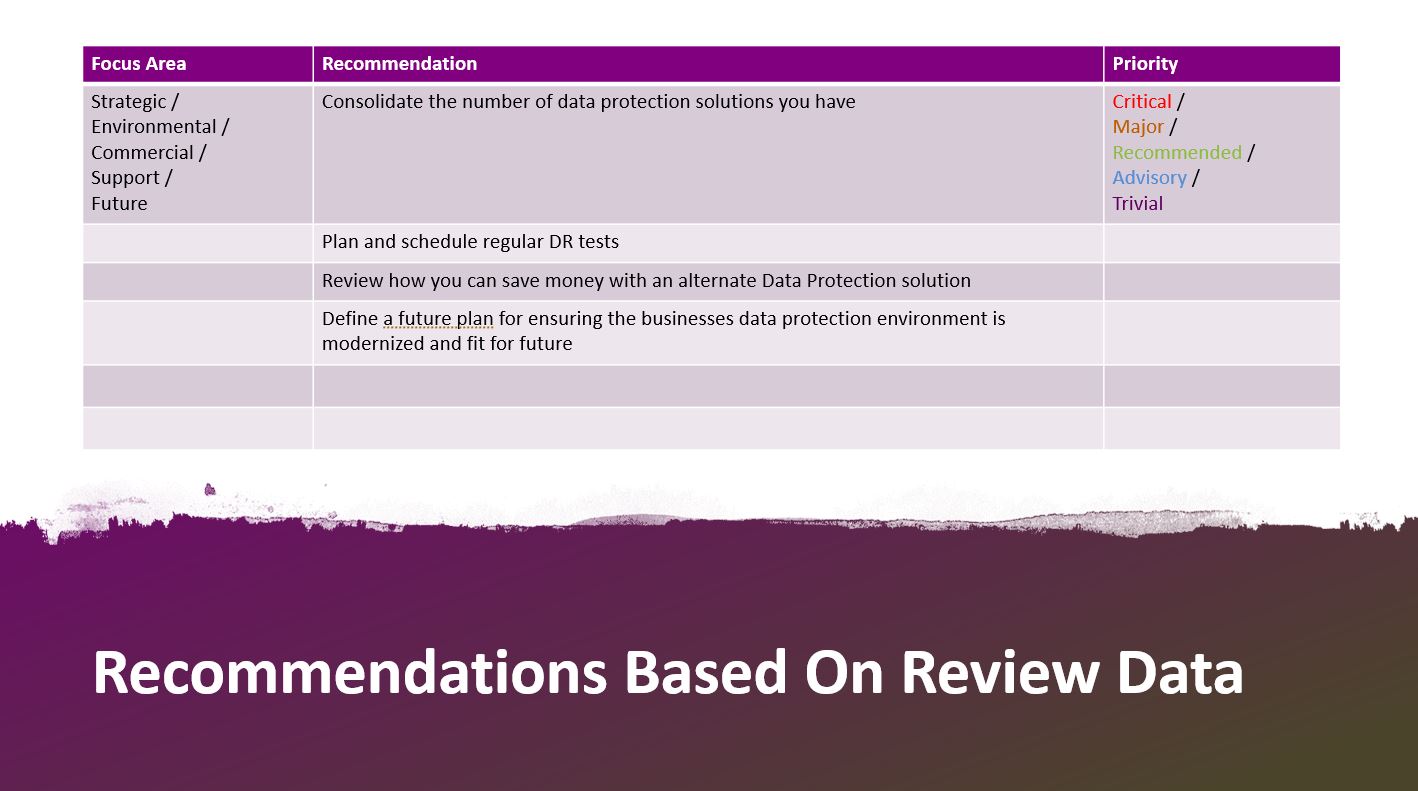
The data protection and recovery review from Catalogic provides a simple set of 12 questions that can be quickly answered to gauge the current state of your data protection environment.


From the questionnaire we will provide a defined output via a PDF report that can be utilized within the business to identify prioritized recommendations to determine the steps necessary to get your data protection environment fit for the future. 


Here at Catalogic we are different to the usual data protection players in the market. 
We offer a fully software-defined solution that enables us to support any block storage behind our backup repository, ‘vStor’, which has data reduction included as standard. 
vStor can also offload to tape and Cloud based S3 storage to ensure more cost-effective targets are available for longer term retention. 

We take a fully consultative approach and ensure customers’ needs are understood and solutions are built around those needs, because out of the box doesn’t fit everyone. 


Our team has been making exciting progress with DPX including the addition of backup and recovery support for SAP HANA databases in DPX 4.6.1. We are also in the process of fully re-defining the user experience within DPX, moving to a more modernized HTML user interface. It’s exciting times here as DPX continues to evolve. 


If you want to learn more about our Data Protection and Recovery Review, take the questionnaire and have us generate the free report or discuss more about Catalogic DPX feel free to get in touch via wbush@catalogicsoftware.com
Thanks for reading and take care. 

10 February 2020

Snapshots are a Feature not a Solution - Part 1

Snapshots are a thing of great beauty and utility. They have enabled data to be protected and reused quickly and efficiently. They now provide many organizations with the foundation of their data reuse and data protection solutions and have regularly saved organizations from major incidents and disasters via the enablement of quick recovery of data.


Storage snapshots are a feature offered via the vast majority of enterprise storage players NetApp, IBM, Pure Storage, Dell EMC and others. The key word in that sentence is FEATURE. Storage snapshots are only a feature and not a complete solution. 

9 February 2020

vStor – The beating heart of our data protection solution

At the heart of every data protection solution is the repository where the data the data protection solution is protecting resides. The beating heart of Catalogic's data protection solution DPX is the vStor.
Our vStor backup repository is a flexible and scalable backup target that frees you from expensive backup appliances and vendor lock-in, unlike many of the current market players. 

Built on open source components, vStor can use any block based storage without restrictions. It supports data reduction in the form of both deduplication and compression for efficiency and provides point-to-point replication for DR or remote office support. 
vStor can be architected to meet your needs. We support physical severs and virtual servers and any form of block storage. 
If you are interested in a dedicated appliance we also offer 3 pre-built vStor appliances – 24TB, 48TB and 100TB. See more details on those here

9 July 2019

Data Protection for the Data Fabric

Last week I had the pleasure of attending the NetApp UK partner academies in Manchester and London. I was pleasantly surprised by the venues, the presenters, the content presented and the number of attendees. 

One thing that was crystal clear is that NetApp are fully focused on enabling customers to build their Data Fabric, regardless of the vendors involved. They have recognised that data is distributed, dynamic and diverse and that each customer is unique, but all are looking to build and enhance a Data Fabric to enable digital transformation. 


Whilst NetApp understand they have the vehicles to store and serve that data quickly and efficiently with their AFF arrays, HCI solutions and Cloud volumes, they are embracing partners such as AWS, Microsoft Azure, Google Cloud, IBM Cloud, Equinix and Catalogic (of course!) to deliver solutions alongside NetApp as part of a customers Data Fabric. 

One customer who has built a Data Fabric based on NetApp is Ducati. Data is a key driver for Ducati and helps determine the construction of the bikes, the performance of the riders and strategy of the team. 
To maximise the impact of Data on the track, Ducati has partnered with NetApp to optimise the team's Data Fabric and meet its unique and expanding data management needs. 
Here's a short video that's well worth a watch with Piergiorgio Grossi explaining how Ducati are transforming the world of racing with data. 
The only spanner in the works for Ducati at the moment seems to be Marc Marquez!
Stick Jack Miller on that Red bike for 2020 and I think they have a good chance of gaining that elusive MotoGP world championship, it's been 12 years since Casey Stoner won it on the Ducati in 2007 (now I feel old!) 

But enough about MotoGP!

In terms of customers Data Fabric's data protection is a key element, it's an element that Catalogic DPX can deliver with our patented block-level incremental backups enabling quicker and more efficient data protection and data recovery capabilities.

DPX extends data protection for the Data Fabric to create a universal data protection, DR and copy services solution. 

By delivering rapid, low-impact backup and near instant recovery, DPX provides modern data protection for the data centre, remote office or cloud. 
DPX can send backup data directly to ONTAP based devices (physical or cloud), or via the vStor software-defined backup repository we can make use of any block based storage. 
Also DPX agents can also replace end-of-life OSSV agents and support the latest versions of ONTAP, this is still a problem a lot of NetApp users are having when moving from 7-Mode to cDOT due to OSSV not being supported on cDOT.  

An overview of the architecture of DPX is shown below

Pretty neat eh! With DPX block-level, file-level, NDMP and agentless VMware backups result in support for almost every operating system.
Heterogenous application-aware support means the vast majority of enterprise applications are supported including Oracle, SQL, Exchange, SharePoint, Db2, Notes, SAP and more - see details here
So as you can see most bases are covered with DPX.

Our recovery capabilities are second to none with instant access, instant and full virtualization meaning we can in the event of a disaster get the Data Fabric back online as quickly as possible ensuring even the most stringent RTOs are achievable. 
We also support bare metal recovery to dissimilar hardware i.e. physical to physical or physical to virtual so in the event your mission critical system running on an a physical system fails you can quickly get back online as a virtual system. 

DPX 4.5.5 has recently been released and there's never been a better time to check out the most comprehensive and affordable data protection solution available for the Data Fabric.
The latest release includes:
✅vSphere plugin for agentless backup
✅Rapid Return to Production (RRP) wizard for agentless
✅Exchange 2019 support
✅SQL Always On Cluster support
Full details on the updates in the release are available here 

If you want to know anything in relation to data protection for the Data Fabric, would like a demo or a free trial of DPX setting up please do feel free to ping me via wbush@catalogicsoftware.com

11 March 2019

Spectrum Protect Plus 10.1.3 – The future of modern data protection has landed

Friday the 22nd of February 2019 saw Spectrum Protect Plus 10.1.3 launched and it’s a release that again see’s the product take some major steps forward in terms of functionality.

The 6 big headlines of the release were:

  • Multi Cloud offload with the ability to offload data to IBM Cloud Object Storage, IBM Cloud Object Storage WORM, Amazon S3 and Microsoft Azure for long-term data retention and disaster recovery
  • Support for Microsoft Exchange Server including individual mailbox item-level restore functionality
  • Optimised offload to IBM Spectrum Protect Server, removing the need for Spectrum Protect for Virtualized environments to perform the offload and enabling enhanced parallel streaming for much quicker offloads 
  • Support for MongoDB enables protection and reuse of business-critical data stored in MongoDB databases
  • High availability of IBM Spectrum Protect Plus Server through VMware and Hyper-V high-availability services
  • Enhanced RESTful API enables easier and faster time to value for reporting and analytics

A full list of all of the enhancements in 10.1.3 are available via https://www.ibm.com/support/knowledgecenter/en/SSNQFQ_10.1.3/spp/r_techchg_spp.html 

23 October 2018

The Modernisation of Data Protection

Data protection is a key business function that enables business owners and executives to sleep safe at night knowing that in the event of data loss their data can be recovered back to an acceptable recovery point, providing regular recovery testing is taking place! 

For many businesses in this day and age an acceptable recovery point is no longer days or hours but minutes or even seconds and that's due to how essential data now is to businesses in the data age. This is a result of the way data is being generated via all of us and our owned devices, that data is then harvested via organisations to gain competitive advantage and grow businesses further.

Google
, Amazon, Facebook, Uber and Tesla are the sorts of companies who are leaders of the data economy and are harvesting data to its full extent and continue to find ways of growing their business via data.


22 March 2018

Hybrid Backup and Recovery Solutions


As the evolution of the software-defined datacentre continues application support for integration with cloud solutions is improving.
One area you all know I’m very passionate about is backup and more importantly recovery and something I’m going to cover in this blog are the significant steps forward that have been made in terms of the enablement of Hybrid backup and recovery solutions.

Tectrade’s Helix Protect appliances began the Hybrid journey back in 2015 when Spectrum Protect version 7.1.3 introduced a new type of storage pool was introduced, a cloud container storage pool.

A container pool is a pool that combines multiple in line data reduction technologies. Data deduplication and compression technology work together to provide effective overall storage savings. Because of this inline data reduction, container storage pool I/O is dramatically reduced, enabling the use of lower-cost disk technology. Inline data deduplication and compression eliminate the need for post processing tasks, improve daily client ingest capacity, and simplify the management of the IBM Spectrum Protect server.

Support has enhanced and as of Spectrum Protect 8.1.4 cloud container storage pools enable data to be stored in the following cloud environments.
Off-premise:
Microsoft Azure Blob storage
Amazon Web Services (AWS) using the Simple Storage Service (S3) API
IBM Cloud Object Storage using the S3 API (IBM Cloud)
IBM Cloud Object Storage using the Swift API (IBM Cloud)
OpenStack Swift with Keystone Version 2, and OpenStack Swift with Keystone Version 1

On-premise:
IBM Cloud Object Storage using the S3 API
OpenStack Swift with Keystone Version 2, and OpenStack Swift with Keystone Version 1

So why are cloud container pools interesting?
Because they enable you to have an offsite storage tier without the investment required in a dedicated DC or co-lo space and the ability to simply purchase storage to store a secondary copy of your backup data on.

A lot of conversations our Technical Sales team are having are focused around Hybrid adoption and how to reduce the footprint of infrastructure in DCs and ultimately reduce cost.
Our goal is always to focus on outcomes and ensure the correct solution is architected for clients and data is stored in the most efficient and cost effective manner but ensuring that the required level of performance and recoverability is delivered. We enable customers to start on the journey of re-architecting there environments via the creation of a service catalogue. If your interested in a sample catalogue and discussion do let us know.
Once the catalogue is clearly defined we then get to work on the realisation of the benefits defined in the service catalogue. This involves ensuring the solution in place is fit for purpose, the correct service levels and cost are associated with the defined tiers and ensuring the data is aligned to the correct tier. 
The solution we use to ensure a best of breed and fit for purpose solution is in place for data protection is our Helix Protect appliance. They fully integrate with cloud environments utilising Spectrum Protect. A sample architecture is pictured below.

20 December 2017

Spectrum Protect 8.1.4 - What's New in the World of Spectrum Protect?

On the 15th of December IBM released Spectrum Protect 8.1.4. 

The release contains a raft of exciting enhancements for us data protection geeks.
If you're a Spectrum Protect customer using the Operations Center, Hierarchical Storage Management, Spectrum Protect for Virtual Environments, Spectrum Protect for ERP, Spectrum Snapshot for Unix, Oracle & SQL or Spectrum Protect for Databases you have something to get enthused about in this release. 

Below is an overview at a very high level of the enhancements within 8.1.4.
Here I'm going to discuss a few key product updates from my perspective.

20 November 2017

Backup and Replication - Why do I need them both?


In this blog post I discuss backup and replication technologies, the purposes of both, what I recommend using and how some vendors are bundling the two functions when not necessarily needed.

The purposes of backup and replication often become blurred due to misuse or misunderstanding of the terms. I appreciate at this point I'm teaching many of you how to suck eggs but bare with me, I promise it gets interesting! 

A backup is a point in time copy of data that enables recovery in a data loss event and also the ability to recover from an earlier point in time so in the event data is changed or becomes corrupted it can be recovered. Typically backup is enabled via a software product or dedicated hardware appliance.

Replication can be a real time or point in time replica of data. In the event of data loss or corruption, data can quickly be brought back online via the replica. Replication if correctly implemented enables a quicker recovery time objective than backup and lower recovery point objective if real time replication is configured. Typically replication is enabled via a software product, built-in application capabilities or via built-in storage mirroring capabilities.

A common question I get from executives is so why do I need both?
The answer to this depends on the regulatory requirements of the business and sector you work in and also the required recovery time objective and recovery point objective of your business. However, in the majority of environments businesses use a combination of backup and replication technologies to provide a comprehensive business continuity plan.
The average cost of outages as detailed via IDC for the Fortune 1000 is $100,000 per hour with the average total cost of unplanned application downtime per year being $1.25 to $2.5 billion! This proves data is the lifeblood of organisations and outages these days have a very high cost to businesses. Therefore ensuring you have a real time replica of data with a tested low recovery point and recovery time objective is crucial.
Point in time replicas or backup is then used to enable the longer retention of data so businesses can recover back over a longer period in time with a lower storage and cost footprint than replication. This is required for a number of scenarios including the event of data being manually deleted via user error, data is corrupted and not noticed for a period of time, they ensure regulatory requirements are met or data has been hit via ransomware and replicated.
Both technologies are delivering SLAs to the business.

24 October 2017

Providing a sustainable method for backing up NAS data


Backing up large network attached storage (NAS) data is typically a painful, clunky and unrealiable process.

Many backup using the Network Data Management Protocol (NDMP), a protocol that enables to transportation between NAS devices and backup devices. 


The main advantage of NDMP is that it removes the need for transporting that data through the backup server itself and can directly offload to secondary storage. 

However it does have quite a few pitfalls including the following:
  • NDMP is not storage agnostic
    In general you cannot backup data and restore to another array from another vendor or sometimes even another OS version. This means you need an identical array to recover onto so it is a very inflexible solution. 
  • The majority of the backup software solutions do not index the files of the NDMP files
    For example in Spectrum Protect you can store a Table of Content (TOC) with the backup but if you want to restore a single file you have to load the TOC into a temporary table to work with it. This is typically very time consuming.
  • NDMP doesn't really support a incremental forever strategy
    That means it doesnt scale well and you have to do a full backup periodically which is a no go with large filesystems at petabyte scale that contain billions of files. 

4 December 2012

The Best Way to Backup a Virtual Machine


New Blogpost on the brand new Tectrade blog written by myself on the best way to backup a virtual machines - Tectrade - Your Information Partner - The Best Way to Backup a Virtual Machine

Keep your eyes on this blog for some more interesting posts on Data Protection, Data Storage, Server Consolidation & Data Placement over the coming months.

1 July 2012

IBM Tivoli Storage Manager for Virtual Environments 6.3

In a nutshell TSM for VE provides protection for virtual machines by offloading backup workloads to a proxy server (vStorage Backup Server) and provides multiple restore capabilities including full VM restore, file level restore and instant restore. TSM for VE 6.3 contains several components which when combined ensure the protection of your virtalised environment these components are shown within the diagram below.